| Tuesday, September 30, 2014 |  |
| Good products |
|
If we simply could keep track of which stuff is good and which is bad, things would be much easier. We aren't good at it, and for that matter, the manufacturers of stuff don't help us very much. In this video I present a Christmas present, a wine bottle opener, which just happens to work really well. It is ergonomic, the motor is strong, the battery lasts for a long time, the foil cutter actually does the job. But it is a no name brand Chinese thing, so it is hard for me to even recommend it to anybody. After some search, and some help from a friend, I figured out that my wine opener is from Dongguan BeneFit Commodity Co.. Unfortunately they don't have that exact same model any longer. Was it a fluke that they made a great product, or do they do it consistently? I don't know. [ Culture | 2014-09-30 23:43 | 14 comments | PermaLink ] More > |
| Thursday, December 1, 2011 | |
| Are jobs becoming obsolete? |
 [This was one of my answers on Quora a while back.] [This was one of my answers on Quora a while back.]
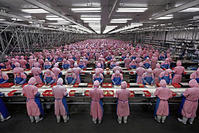
The idea that there's a paying job waiting for everybody is going away. It was a somewhat odd idea in the first place. Before jobs were invented, people mostly worked to house and feed their family. Quite strikingly, they did this by actually building the house and by actually growing the food. Nowadays, that's close to being illegal, as you most likely would violate building codes and zoning laws if you tried to do that in a western country. What happened in the meantime was that a very complicated system was invented, where one would go out and work for other people, then buy what one needs from others, before one can go back home and enjoy it. One of the problems with the scheme is that there's no very good regulating mechanism for jobs. There's one for money, albeit a flawed one. If there is not enough money to pay for stuff, central banks have the job of putting more money into circulation. If there's too much money out there, it is their job to get rid of it, thus keeping the money supply fairly stable, corresponding roughly to what is there to pay for. Again, there are many problems with this, but at least there's a system to keep it stable. There's no system that automatically creates more jobs when there are some people who need them, or that retires some jobs if there's nobody to fill them. Governments try to do it, but unless they're centralized socialist governments, they don't have direct ways of doing it. A direct way would be to hire more people if there are people without jobs. What they do is indirect stuff, in the form of "stimulating" the economy in various ways. Sometimes they do this in ideological ways that might not even work, or that might do the opposite. For example, there's the supply-side philosophy that is popular with neo-conservatives in the United States. The idea is that if you give more money to rich people, they're smart enough to do things with it that creates more business, and thus more jobs. Then again, they might just invest it in some other ways, or buy gold-plated swimming pools for it. Or they might buy robotic factories, not creating very many jobs. Supply-side is seen in contrast to demand-side economics, which would stimulate the economy by giving regular people more money, inspiring them to go and spend it, thus getting the wheels turning. There's no guarantee that this creates more jobs either, as the stuff people are buying might still be produced in robotic factories and in another country. More things are being produced with less and less effort. Production is becoming automated. Fewer and fewer people can create more and more. This increased efficiency could potentially do many good things, but what it certainly doesn't do is produce more jobs. It naturally produces fewer jobs. And the benefits of the increased efficiency are largely kept by the owners of the production machinery. Yes, people get cheaper stuff too, but they don't get the jobs that would pay them so they can afford to buy it. This system is going to break sooner or later, but that's a different discussion. In the meantime, jobs are being replaced, increasingly, with being in business by yourself. You'll have noticed, even if you have a job, that you've had to compete to get it, to market yourself, to track down prospective employers, package yourself right, etc. There are rather few jobs just standing around waiting for you. Jobs aren't secure either, even if you have them. It is extremely unlikely to last your whole life, so you'll have to do it over and over. So, more people are going on to the next step, of being freelance and learning how to actually market their services, find customers, etc. Since you're becoming freelance anyway, you're also more likely to choose a line of activity that actually interests you, more than a regular job would. Another intriguing trend is likely to close the loop and take us back to a more sustainable and local way of living. As technology advances, it becomes possible to manufacture more stuff by yourself. Think about 3D printers and open source hardware and software. As the global economic system is becoming more uncertain and unstable, we perceive more of a need for taking care of our needs locally. The right combination of technologies will increasingly make it possible. So, one way or another, we're actually quite likely to get back where we started, but at a much higher level. I.e. that you work on what you actually need and what you feel like working on. You will need to network economically with other people, but no job needs to be involved. It would be a good idea to start right now to get used to the idea. Drop the job thinking. Think about having skills that will be needed and useful, whether there's a job for it or not. Think about understanding who needs your services and how you can reach them. Think about organizing your life so that you might still eat and have a place to live, even if business is slow. [ Culture | 2011-12-01 17:56 | 27 comments | PermaLink ] More > |
| Sunday, November 20, 2011 | |
| Order and violence |
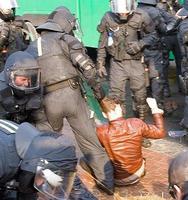 The governments and the culture of many countries will enforce order, no matter what amount of violence is necessary. United States is noteworthy among them, as most of the rest are non-western dictatorships, like a number of middle eastern countries such as Syria, Bahrain or Saudi Arabia, and countries such as China, North Korea, Iran, etc. The governments and the culture of many countries will enforce order, no matter what amount of violence is necessary. United States is noteworthy among them, as most of the rest are non-western dictatorships, like a number of middle eastern countries such as Syria, Bahrain or Saudi Arabia, and countries such as China, North Korea, Iran, etc.
In countries that are ruled by violent enforcement of order, even the most innocent offense will escalate to deadly force, if the offending party fails to succumb and comply. As an example, let's pick a quite innocent event like a parking violation, and as the stage, let's pick the United States. Most Americans will vehemently deny that a parking violation would ever escalate to anything violent, but that just shows how well conditioned they are to accept such a system without question. Let's say I park my car in some annoying spot, like on a corner in a busy intersection. People can just drive or walk around it, so it isn't like it would stop traffic, but many people would be irritated about it. A cop will probably be around to leave a ticket on the windshield rather quickly. If I simply drive away and pay the ticket, nothing else happens. If I choose to stay, a tow truck is likely to show up. It it really was a very annoying spot, it will show up quickly, otherwise it might take days. The tow truck will try to move the car away. If it succeeds, nothing much more happens, other than that I would have to come up with quite a bit of money to get my car back. But imagine that I take steps to make sure my car stays there. Maybe I drive steel pylons into the roadway under my car, welded to the frame. The police will command heavier equipment into operation. In case I'm still inside the car, they'll break open the doors or smash the windows, and put me in handcuffs and drag me away. But say I passively resist them doing that, insisting on staying there. My car might well be armored, equipped with bulletproof glass. They'll get more creative and bring bulldozers and they'll inject teargas or similar stuff into the air supply. Imagine that I've taken steps to still stay exactly where I am. Sooner or later, and it won't even take long, they will bring in tanks and there will be snipers on the roof tops. Remember, I'm still not doing anything other than staying in an illegal parking space and failing to be removed. Along the way there will be a continuous stream of opportunities for me to do something that would be interpreted as being worse. If I stand up on the roof of my car and yell and wave my arms, that would be a sufficient excuse for one of the snipers to take me down. Let alone that I had the thought of actively defending myself against one of the assaults they would think up, such as throwing the tear gas back to them, or disabling the bulldozers that try to remove my car. But even just by staying there, successfully not being removed, I become guilty of more and more serious crimes. Resisting arrest, destruction of public property. Won't take long before it is considered some kind of terrorism. And sooner or later, either I succumb and obey, or they win and force me to obey, or they kill me. No other outcome is likely, unless I somehow became very popular and public opinion starts supporting me very loudly. If not, I either obey or I'm forced to obey, with deadly force if necessary. A typical law-abiding citizen will say that this is a really stupid example. All I'd have to do at any time would be to do what the police tells me to do. The escalation stops the moment I obey. So, if I don't, it is surely my own fault. I've been given every chance to comply, and if I then still don't, I'm obviously an idiot and a criminal and I deserve anything that happens to me. I should note, for the sake of my American friends, that this kind of escalation is not what would happen in any European country. And, sure, in some countries it would happen much faster, and they might just shoot you up front to get it over with. But in most Western countries, there's no system of automatically escalating violence used against regular citizens. If you really can't be moved, even after reasonable measures have been put into play, you'll obviously be giving a big problem to some kind of governmental agency. But that will most likely lead to a lot of talk and negotiations and thinking. It would be much more likely that they would move the whole street than for anybody to consider using deadly force. This is a very current subject, as police forces all over the U.S. currently are using excessive violence on peaceful protesters that are guilty of no other offense than not moving when they're being asked to. They're beaten up, subjected to chemical weapons, acoustic weapons, their property is being destroyed, they're arrested for charges made up on the spot. And the consequences are only this "mild" because the police manages to drag these people away relatively easily, because they're unarmed and not actively resisting. If they actually were able to stand their ground more effectively, however non-violently and passively, they would be subjected to much higher degrees of violence and deaths would be inevitable. The point is that this is a very bad system. Not the specific laws and punishments. Not the particular local police chiefs. They might or might not be bad too, but the problem is the overall principle. The basic idea that there MUST be order, that people MUST do what they're told, and if they don't, an increasing and limitless amount of force will be applied to make them comply, even if the force is totally out of proportion to the initial offense. Luckily, these things attract a lot of attention. No, not my fictitious parking violation. Police brutality against peaceful protesters attracts a lot of viewers in a variety of media. A woman being stoned for adultery in Afghanistan, that easily attracts international attention as well. The world is indeed watching. Lots of people still think that the victims of such brutalities should just have "done what they were supposed to". But a growing number of people think otherwise. If clear attention is focused on the central model that is at fault, it can be changed. [ Culture | 2011-11-20 23:39 | 6 comments | PermaLink ] More > |
| Tuesday, November 15, 2011 | |
| Being prepared |
 Did you ever notice how, when you're well prepared for something, it is much less likely to be a problem? No, not just in the obvious way, that you're less likely to get wet when you bring your umbrella. It is altogether less likely to rain if you bring your umbrella. Your preparedness changes the world you'll experience. Did you ever notice how, when you're well prepared for something, it is much less likely to be a problem? No, not just in the obvious way, that you're less likely to get wet when you bring your umbrella. It is altogether less likely to rain if you bring your umbrella. Your preparedness changes the world you'll experience.
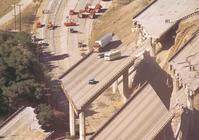
I lived in L.A. for many years. California is earthquake country. For the longest time I had in the back of my head the worry about The Big One hitting one day. That is, until I prepared for it, and it then happened and wasn't a big deal. At some point in the autumn of 1993 I got the strong feeling that a big earthquake was coming soon. Checking with some of my more psychic friends, a bunch of them felt that too. We even had a collective hunch of a particular weekend when it would happen. I took it quite seriously. So, we prepared. I went out and bought earthquake supplies, filling up a number of cardboard boxes in the garage. Canned food, water, thermal blankets, stuff for purifying water, wrench for turning off the gas, first-aid kit, wind-up radio, etc. And I did earthquake drills with the whole family. We found the safest spots in the house, practiced what we'd do, talked it through, etc. Then, on the appointed weekend... nothing happened. Oh, a 6.0 in the desert on the Nevada border, but that's hardly worth mentioning. Nothing happened in our area. And we quickly forgot about it again. Until early one Monday morning a few months later when I got jerked out of my sleep in the dark by the house apparently being violently thrown back and forth for a rather long time. Doors slamming, bookcases falling, glass shattering, furniture, refrigerators, everything sliding across the floor. No electricity, so I was dodging these various moving objects, still in the dark, to go see if everybody were alright. We had 4 kids in the house that night, our own + 2 of the neighbors. As it turned out, each one had been just barely missed by some heavy falling object, like a TV, but nobody got hurt. This was the 1994 Northridge Earthquake. The epicenter was just a block from our house. Not that our area was the hardest hit in any way, but it was bad enough. In the little published overview of the magnitude by zip code, in our neighborhood it was an 8.9 magnitude earthquake. Overall it got a rating of 6.7 on the Richter scale. Freeway bridges fell down as far as 20 miles away. Everything made of brick in the whole San Fernando valley seemed to have falled over. Luckily, nothing important is made of bricks in those parts. Anyway, the point of my story is that before my previous earthquake preparation frenzy, I had been afraid of earthquakes. It was an anxiety in the back of my mind, which made me wonder if we maybe should move. Then I became prepared. And, when it happened, despite me not noticing before later, I was in no way afraid. I was effective, I did what needed to be done. Went to turn off the gas and patch up the broken water pipe in the garage which was spraying water all over everything. Got us all outside, hooked up with the neighbors, etc. Overall it was a rather exciting event, giving rise to a number of positive experiences and enlightening learnings. It was fascinating to see how people's personal stories and expectations played out in a situation like that. It was inspiring to see the community self-organization that happens in a crisis like that. That morning, the whole street was out having a barbecue potluck party in one of the front yards, watching a little battery driven TV for news. That became the beginning of block parties, a neighborhood watch program, etc. I no longer thought about maybe finding a better place, something more safe and ideal. Rather, what I took away from it was that wherever you are is the right place to be. There are no safe places, but there are safe people. If you're prepared, most things aren't really all that bad. If you prepare for something "bad", it probably isn't going to be all that bad. Or if it is, you'll know what to do about it. So, if you're prepared, and the people you know are prepared, you can stop worrying about it, and put your attention to more enjoyable matters. So, not only do you save yourself a lot of anxiety, but it is a lot more comfortable to prepare for things in advance. It is a lot easier to prepare to have a source of drinking water when the stores are open and your Internet connection works than it is when you're thirsty and nothing is open, because of some kind of minor or major breakdown. It is a lot easier to think of how you'll charge your cellphone or your radio before the electricity actually goes down. A lot of things that could happen might not happen. But, seriously, you're going to help them not happen by being well prepared for their happening. Have an umbrella ready, so it won't rain. Or, in case it actually does, we'll be dry. [ Culture | 2011-11-15 23:30 | 4 comments | PermaLink ] More > |
| Thursday, November 10, 2011 | |
| World Transformation |
 For around 10 years, this has been the tagline of this blog: For around 10 years, this has been the tagline of this blog:
An old rigid civilization is reluctantly dying. Something new, open, free and exciting is waking up. Sounds fairly radical. But at the same time it wasn't promising anything. We might be talking about the next 100 years, and it might happen very slowly. I didn't really know when or how quickly. But everything suddenly looks quite different. Something is awakening in The People. While things are falling apart more shockingly than ever before. This might just be the beginning, and things are likely to suddenly happen very, very fast. Probably plenty of people are still able to pretend nothing is going on. They can go to work every day, stay busy, discuss politics, plan their retirement. They might wonder how things will be in 20 or 30 years, and honestly expect that everything just develops fairly linearly from here. Their investments will have grown. Cars will have more cool electronics. Everybody has solar panels on the roof and recycling is really efficient. You'll have more Terabytes in your computer. There will be some new shows on TV. I bet you'll have a hard time recognizing the world even just a year from now. Expect an accelerating stream of discontinuous changes. Stuff that nobody expected, which then leads to other things that we expected even less. But you won't just be the audience. You might be surprised to find that what you do really does make a difference, and that it isn't just a nice motivational thing to say. You certainly also have a choice. What is changing isn't just one thing, and it isn't just changing in one way. You have the option of choosing which future you're joining. And, sorry to say, if you're choosing the status quo, it might become a bit unpleasant for you. If you stay open and flexible, you might find that it will be as the tagline promises: new, open, free and exciting. It is simple enough, really. You don't have to know the outcome in advance. Just, when you have a choice in front of you, choose! The only hint you need is to choose the new, exciting thing that's emerging, not the stuff old thing that's falling apart. Be the wave, surf the wave, don't bother reinforcing the straw hut with bricks if it is going to be submerged shortly. Enjoy the ride. [ Culture | 2011-11-10 01:11 | 4 comments | PermaLink ] More > |
| Wednesday, February 23, 2011 | |
| The Collective Intelligence Singularity |
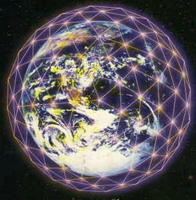 I don't really believe in The Singularity, in the sense that there's a rapidly approaching point in time when computers become much smarter than humans, so much smarter that they take over the control of the further evolution of society. I don't really believe in The Singularity, in the sense that there's a rapidly approaching point in time when computers become much smarter than humans, so much smarter that they take over the control of the further evolution of society.
Generally speaking, the idea that there's an accelerating curve of machine intelligence, leading to the machines taking over some time soon seems a little silly to me. There's an accelerating curve of processing power, and there's an accelerating curve of many other interesting things. But if you're talking about conscious machines, there's simply no curve. No computer has been shown to have any kind of consciousness whatsoever. None. Neither has any other machine we've constructed. You can program computers. Given more processing power and better algorithms, you can program computers to solve more and more problems in more flexible ways, running on their own more of the time. That's great. But to simply hope that somewhere along the way, bing, a miracle happens and suddenly they become conscious as well, that's a little naive. It would at least make sense to first try to understand what consciousness is. But there are other singularities that are likely to happen relatively soon which are equally interesting, and much preferable. Most interesting to me would be the collective intelligence singularity which might well be just a couple of years away. I.e. there's a point where we, as a group, a society, a planetary population, become smarter than any one of us. Not only that, but smarter than any one of us is able to understand. We right now already have a hard time understanding the world, but the collective intelligence isn't yet particularly clever. At some point it might actually really, really start working, and we'll not be able to understand exactly why. For that matter, this could very well happen in 2012. You know, since many of us are looking towards some kind of cataclysmic event happening then. So, instead, it might very well be a monumental leap forward in our collective evolution. Not the end of the world, but the end of a world that can be dominated by individuals. A world where 6 billion people actually are smarter than any 1, 10, 100 or 1000 people, however rich and powerful and smart they are. You see it beginning to happen right now, in the form of a series of uprisings against authoritarian governments. None of these revolutions are terribly intelligent, but they surely demonstrate that a large group of people is stronger than one strong guy and his hired hands. That's surprisingly something new. The masses can get rid of the guy at the top, even and particularly if he is a billionaire and a mass-murderer, and then they can actually self-organize in constructive ways. The global Collective Intelligence is certainly technologically amplified. The Internet is its nervous system. In all its forms: SMS, Twitter, Facebook, Skype, e-mail etc. But it is important to realize that it is not something foreign that is going to "take over". It is all of us. We The People. Humanity. The fact that a few desperate dictators keep trying to shut down or control electronic communication among "their" people will ensure that the network will evolve more rapidly to the point where it really can't be shut down. There are many things going on right now that are leading in the same direction. WikiLeaks makes it a bit harder for the few to hide big bad things from the many. Natural catastrophes accentuate the need for rapid ad hoc self-organization. Who knows what is going on? Are the people I know safe? How can I help? It is becoming harder to lead large populations along based on lies, and it is becoming easier for large populations to figure out together what is going on and what needs to be done. Collective Intelligence is emerging. It needs to develop more internal complexity, of the good kind, more connections, a more fine-grained neural network. But that can happen very quickly. There's nothing essentially new that needs to be invented first. It will take most of us by surprise. Then again, it won't. It will take those few people by surprise who think it is up to them to make the world work, by owning or ruling most of it. The rest of us will be a bit surprised too, but at the same time we have an intuitive sense of it. No matter what political observation we think we adhere to, most of us have a sense of being part of The People, and we'd be quite satisfied to see that suddenly The People seems to know how to act in a sensible way. Things seem to strangely be getting better. So, here's my prediction: Before the end of the year 2012, next year, there will be a widespread realization that something profound has changed. Together we are undeniably more than any one of us possibly can be. People in power can no longer keep their sordid secrets, and for that matter, suddenly nobody can stay "in power" through the traditional means. Big problems get sorted out by self-organized networking. Suddenly, the more people get involved in something, the better the outcome tends to be. It is puzzling, and nobody can easily put their finger on how or why it changed. The best solutions are typically found, and the truth tends to emerge. It is a singularity because, once it happens, there's no way back. You can't shut it off any longer. And none of us can completely understand it, or predict what it will do next. But at the same time, we will probably increasingly have a shared feeling of it. Because, again, it is us. [ Culture | 2011-02-23 23:12 | 10 comments | PermaLink ] More > |
| Tuesday, June 16, 2009 | |
| Baseline technology |
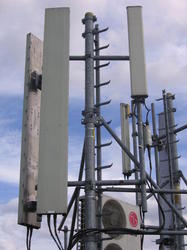 What is the baseline of technology that can be available to anybody? How can the bar be raised, and secured? What is the baseline of technology that can be available to anybody? How can the bar be raised, and secured?
There is a lot of power in being the authority who decides whether people are allowed to have access to a technology or not. A lot of the technology we're taking for granted is very fragile and can easily be turned off. The government of Iran turned off the SMS network during their phoney elections, because they knew that the opposition would use SMS to organize. How can we organize stuff, knowledge and technology and communication in particular, so that it can't be shut down at the whim of people in power? We'd like to imagine that the Internet is a thing like that, which routes around damage and which can't be shut down. Which would be nice, but it probably isn't true. They can filter all internet traffic for all of China. They can leave it out altogether in North Korea. And a few backbone providers control the big pipes that it all goes through. None of it would work without the root name servers and the domain registries. It is very far from the grassroots thing we somehow imagine it to be. But one could as well invent an internet that actually really couldn't be shut down. Something with a mesh network over radio, something that people could solder together even if their government didn't like it. It goes through all aspects of our society. We're extremely dependent on stuff that is incredibly centralized and outside our sphere of influence. Most of the elements of our civilized existence could be yanked away in anything from seconds to days. By governments or by catastrophe or by business interests. I'd prefer for our civilization to be more resilient than that. Which it would be if most of us would be able to jumpstart important elements of our existence, in case they are missing one day, for whatever reason. Food - what would you do if your local supermarket didn't get any more deliveries, or they no longer accepted your plastic card to pay for it? It is quite easy to grow food yourself, but are you? Communication - if you get locked out of the internet or the phone network, because you downloaded a pirated movie 3 times, or because your government decided it is bad for your morals, or because of some systemic failure - what would you do? Wait until it came back? That's a bit pathetic. Manufacturing - what could you manufacture if it somehow wasn't available in the store any longer? What could you manufacture if you were stuck on a desert island? Shockingly little. But if you were better educated, you'd get much further. Buckminster Fuller defined wealth as the number of days forward that you could sustain a certain group of people. A zillion dollars does you no good if the stores and banks are closed. The real wealth is that you can make stuff that sustains life, without needing permission from anyone. Previously: Immaculate Telegraphy [ Culture | 2009-06-16 00:39 | 10 comments | PermaLink ] More > |
| Sunday, June 7, 2009 | |
| The Giant in Nantes |
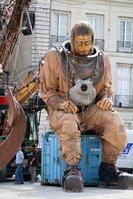 Ah, I love these Royal de Luxe performances, even though I so far haven't caught one in person. The closest I've been is an exhibit of some of their past creations, which included wonders such as a piano throwing machine. But these giant spectacles is their very best stuff. Here's the latest, from today in Nantes in western France. The giant deep-sea diver has been looking everywehre for his lost giant niece, over the past hundred years. Will he find her? Ah, I love these Royal de Luxe performances, even though I so far haven't caught one in person. The closest I've been is an exhibit of some of their past creations, which included wonders such as a piano throwing machine. But these giant spectacles is their very best stuff. Here's the latest, from today in Nantes in western France. The giant deep-sea diver has been looking everywehre for his lost giant niece, over the past hundred years. Will he find her?
YouTube video here. [ Culture | 2009-06-07 15:00 | 15 comments | PermaLink ] More > |
| Tuesday, October 14, 2008 | |
| Money and the Crisis of Civilization |
 Brilliant article by Charles Eisenstein. Maybe nothing I didn't already know, but plenty that strangely has remained secret for most people. What money really is, where it is coming from, and why things aren't going well for "the economy". One should learn it in school, it should be explained on billboards. There should at least be programs about it on TV. But no, I've never seen any program on TV that even hinted at it. Strange, as it is so shockingly simple. Brilliant article by Charles Eisenstein. Maybe nothing I didn't already know, but plenty that strangely has remained secret for most people. What money really is, where it is coming from, and why things aren't going well for "the economy". One should learn it in school, it should be explained on billboards. There should at least be programs about it on TV. But no, I've never seen any program on TV that even hinted at it. Strange, as it is so shockingly simple. There is a much deeper crisis at work as well, a crisis in the creation of goods and services that underlies money to begin with, and it is this crisis that gave birth to the real estate bubble everyone blames for the current situation. To understand it, let's get clear on what constitutes a "good" or a "service." In economics, these terms refer to something that is exchanged for money. If I babysit your children for free, economists don't count it as a service. It cannot be used to pay a financial debt: I cannot go to the supermarket and say, "I watched my neighbor's kids this morning, so please give me food." But if I open a day care center and charge you money, I have created a "service." GDP rises and, according to economists, society has become wealthier.It is first of all a shockingly well-kept secret that money is created when a bank lends it out, and in no other way. It is very poorly understood that when money is created, more money than what was created is needed to pay it back (the interest), which is mathematically impossible, except for if the pyramid scheme can be kept going indefinitely. And there's obviously not widespread understanding of the systemic implications of this whole thing. The system requires that we keep inventing more and more things that we can keep from other people unless they pay us. It is all a big scam, but you're hard pressed to find anybody who'd admit it. [ Culture | 2008-10-14 19:56 | 15 comments | PermaLink ] More > |
| Thursday, May 8, 2008 | |
| Why Denmark is the world's happiest country |
 It's an article on Tim Ferriss' excellent blog: "6 Reasons to Visit the World’s Happiest Country". Makes me feel good about being Danish. It's an article on Tim Ferriss' excellent blog: "6 Reasons to Visit the World’s Happiest Country". Makes me feel good about being Danish. 4. The people are beautiful but seem unaware of the fact. [ Culture | 2008-05-08 23:01 | 12 comments | PermaLink ] More > |
| Friday, February 22, 2008 | |
| God talks about Richard Dawkins |
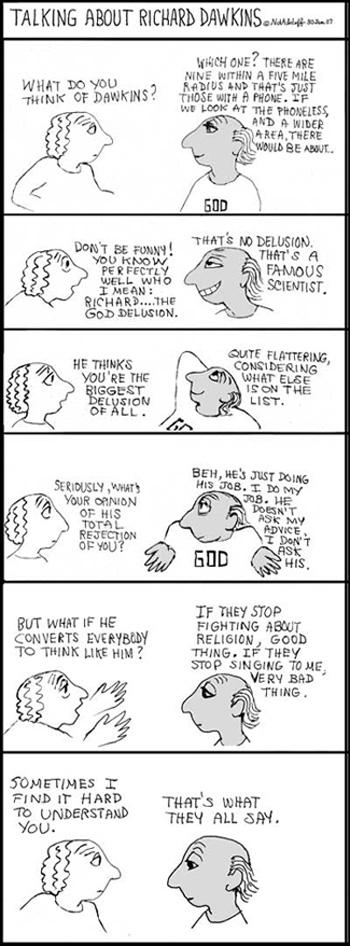 By Blaugustine, from here [ Culture | 2008-02-22 14:42 | 10 comments | PermaLink ] More > |
| Monday, December 3, 2007 | |
| Megadukkhas - quantifying suffering |
 As a sub-theme in an article about Root Irresponsibility for Major World Problems, Tony Judge touches on the strange unit of measure called a "dukkha": As a sub-theme in an article about Root Irresponsibility for Major World Problems, Tony Judge touches on the strange unit of measure called a "dukkha": The most extensive and insightful methodological approach to the incidence of suffering is that developed through the research of R G H Siu and the International Society for Panetics. They developed the concept of the "dukkha" as a measure of suffering. For the panetics community, the dukkha is a measure of the intensity and duration of pain and anguish adapted from the 9-point hedonic scale used to provide subjective judgements in market research. Dukkha is also a central concept in Buddhism.Wow. dukkha is of course a traditional Buddhist term, which is probably somewhat mis-translated and mis-understood from its original meaning, but which is typically translated as "suffering". Read more about dukkha as a unit of measure here. I never heard about dukkhas or megadukkhas before. Of course it would be tricky to measure in any precise way, but just the concept that one could quantify suffering opens a bunch of doors. See, stuff that can't easily be accounted for tends to become somewhat invisible in our kind of society. Particularly if it can't be counted in dollars, but also simply because it is difficult to count, or it isn't counted. In the many years I've lived in L.A. I've had hundreds of hours to sit in bumper to bumper traffic and ponder the outrageous and unnecessary waste of time and resources that is going on, not to mention the anger and suffering from people sitting in their cars going nowhere. The suffering is relatively minimal if we compare to the hundreds of millions of people in other parts of the world who starve, who're tortured, who's family members are killed, who don't have health care, etc, but if we add it up it wouldn't be all that minimal. But just think about the cost to start with, if it actually were accounted for. Say I could get to work in downtown L.A. in 15 minutes, if the traffic actually was flowing, but it takes me an hour. That means I spend 1.5 hours per day doing nothing useful, while burning gasoline and sitting being frustrated. If we only looked at the time aspect, then me and the other 2 million people who're doing the same will waste around 3 million hours that day. Multiply that by the $20 or so we get paid by the hour for working, and you have $60 million in a day, or around $18 billion per year. You could buy a hell of a lot of freeway for that. Tripple-decker underground freeways would be perfectly feasible if you accounted for the time and money that would be saved. Or think of it on a daily basis. There's a stalled car in one of the lanes 2 miles further along, and thousands of people suddenly waste thousands of hours when the traffic grinds to a halt. If you account for that cost, even drastic measures would be perfectly economical. You could keep a Sikorski crane helicopter hovering over every section of freeway 24/7 ready to lift any stalled vehicle off the freeway, and the cost would be completely negligable in comparison. But I'm getting distracted. This was about suffering. Imagine that we could find ways of reducing the overall suffering on the planet. That's what the Institute for Panetics is working on. They propose principles and awareness campaigns for different sectors of society. Law and order, media, health, religion, government, etc. Here are some definitions and objectives: WHAT IS PANETICS?That's a wise and noble endeavor. Of course, making words for it, creating units of measure, outlining principles - it makes it something one can begin to think about. Think with in constructive ways, where one can make better decisions, as opposed to just walking around with a generalized gloomy feeling about the world. You can actually to some degree add it up. Does option A or option B best reduce the amount of suffering in the world? If consequences can be identified, labeled and accounted for, it is so much more likely they will become part of the decision process. There are consequences like pollution, wasted time, wasted money. If the bill could be sent to those responsible, they just might have to make different decisions. And there's the consequence of pain and suffering. Which isn't just a matter of sending somebody a bill. Suffering sucks. A little suffering once in a while might motivate you to make things better. But a lot of continued suffering just makes life suck a whole lot. So, I'm all for a global megadukkha reduction act. Down with the dukkhas. Of course we need a unit for happiness too, then. Just sitting around not suffering doesn't automatically make life great. Let's max out the joy and happiness counters while we're at it. [ Culture | 2007-12-03 22:40 | 7 comments | PermaLink ] More > |
| Sunday, December 2, 2007 | |
| The QuestionAuthority Proposal |
R.U.Serius has a proposal: A dark cloud is passing over America. We've witnessed, in recent years, the death of many of our constitutional rights and liberties. We've also seen increasingly authoritarian trends in daily life and culture.And he also proposes an Open Source Party. [ Culture | 2007-12-02 20:49 | 3 comments | PermaLink ] More > |
| Thursday, July 5, 2007 | |
| An Earth without people |
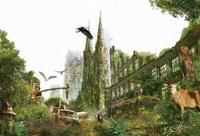 I've read similar things before, and it always puts our civilization a bit in perspective. Science writer Alan Weisman has written a book called "The World without Us", and Scientific American has an article: I've read similar things before, and it always puts our civilization a bit in perspective. Science writer Alan Weisman has written a book called "The World without Us", and Scientific American has an article:According to Weisman, large parts of our physical infrastructure would begin to crumble almost immediately. Without street cleaners and road crews, our grand boulevards and superhighways would start to crack and buckle in a matter of months. Over the following decades many houses and office buildings would collapse, but some ordinary items would resist decay for an extraordinarily long time. Stainless-steel pots, for example, could last for millennia, especially if they were buried in the weed-covered mounds that used to be our kitchens. And certain common plastics might remain intact for hundreds of thousands of years; they would not break down until microbes evolved the ability to consume them.It is an interview too. Here's a tidbit: Q: If human beings were to disappear tomorrow, the magnificent skyline of Manhattan would not long survive them. Weisman describes how the concrete jungle of New York City would revert to a real forest.There's something strangely fascinating about the vision of nature taking over after humanity disappears. An overgrown New York, again having hills and streams, and the Statue of Liberty's torch sticking out of a beach somewhere. I can't quite decide which side I'm on, nature's or ours. But I hope it won't keep being a matter of sides, and that we'll work it out in more harmonious ways. [ Culture | 2007-07-05 23:30 | 2 comments | PermaLink ] More > |
| Monday, July 2, 2007 | |
| Green hotel built in a Chinese quarry |
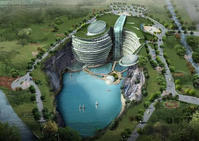 Inhabitat: Inhabitat:Near Shanghai, the Songjiang district has become a popular weekend destination for many tourists with its natural beauty and sprawling landscapes. And now the Songjiang Hotel might just become the newest and greenest attraction. While it may look a bit sci-fi, this hotel was designed for the real (green) world, with many sustainable features in mind. [ Culture | 2007-07-02 21:55 | 1 comment | PermaLink ] More > |
| Thursday, June 28, 2007 | |
| How the record industry committed suicide |
Rolling Stone has the first of a two part series declaring the music industry dead, by suicide:So who killed the record industry as we knew it? "The record companies have created this situation themselves," says Simon Wright, CEO of Virgin Entertainment Group, which operates Virgin Megastores. While there are factors outside of the labels' control -- from the rise of the Internet to the popularity of video games and DVDs -- many in the industry see the last seven years as a series of botched opportunities. And among the biggest, they say, was the labels' failure to address online piracy at the beginning by making peace with the first file-sharing service, Napster. "They left billions and billions of dollars on the table by suing Napster -- that was the moment that the labels killed themselves," says Jeff Kwatinetz, CEO of management company the Firm. "The record business had an unbelievable opportunity there. They were all using the same service. It was as if everybody was listening to the same radio station. Then Napster shut down, and all those 30 or 40 million people went to other [file-sharing services]."(Via BoingBoing). Yeah, one can't really imagine how they could possibly have acted more stupidly. Thousand times worse than the guy who invented new Coke. [ Culture | 2007-06-28 22:21 | 4 comments | PermaLink ] More > |
| Wednesday, June 13, 2007 | |
| Story Fields |
 An excellent article by Tom Atlee, Story Fields. An excellent article by Tom Atlee, Story Fields. A story field isI'm very interested in stories and metaphors right now. Stories are strangely powerful and almost invisible structures. One apparently simple story can guide the behavior of individuals and groups and countries. Yes, quite meaningful to call it a field. It is a self-contained, self-consistent package of meaning, which, if accepted, carries a whole set of beliefs and norms and behaviors with it. There are various ways of working with that. Like, there is metaphors and stories as a therapeutical tool. A strangely effective technique for a skilled therapist is to simply tell a story. Not just any story, but if you have managed to pick up a structure of the person's situation, problems, etc, and you present them with a carefully crafted story with the same structure, but different content, and a story that actually gets resolved, it might act as a powerful metaphor for the person, and might translate into reality. Likewise for any kind of communication to groups of people. A story or a metaphor can be worth a thousand pictures, each worth a thousand words, so to speak. If it is the right metaphor at the right time, it might change everything. But stories is also simply how we manage to live within a common field, adhering to similar meta-beliefs, despite doing very different things and living different lives. And stories aren't necessarily just what can be told as what we recognize as a story, but they still follow similar principles. OK, back to Tom's article: Consider an example. Many people around the world have a powerful (although not always articulated) sense of THE AMERICAN WAY OF LIFE. Probably the vast majority of Americans are actually motivated by that sense. We could describe it in terms of principles -- like freedom, individualism, patriotism, progress, mobility, property rights, the pursuit of happiness, and so on. But to fathom the compelling nature of The American Way of Life, we need to step into the stories that generate it. See what comes up for you when you consider the following evocative images: Pioneers. Cowboys. The Declaration of Independence. Manifest Destiny. Rags to Riches. Technological Progress. The World's Only Superpower. The Career. The Work Ethic. The Wise Investment. The Safety Net. Family Values. The Melting Pot. The American Dream. The War on Terror.Notice that the story doesn't have to be true. That's not the point at all. The United States is not particularly more free than most other places, rather it is less free in many ways than most other Western countries. And most people really don't make it from rags to riches. But the story is very pervasive, and even large amounts of facts don't change it much. A story can change of course. And some stories really ought to change. Read Tom's whole article for hints on how. It isn't necessarily easy to change a big story, one that whole cultures live on. But it is easier if one has a certain awareness of the playing field. It isn't about arguing against the existing stories. It isn't about stacking up facts for or against. It is maybe about creating a better story. Stories can have many components, like imagery, sayings, archetypes, anecdotes, etc. A lot of that can be developed. But somebody has to plug into the whole thing, to tend the forest and not just the trees. There's a need for imagineers. Also see Jon Lebkowsky, and read Wikipedia on Narrative Paradigm. [ Culture | 2007-06-13 22:18 | 3 comments | PermaLink ] More > |
| Tuesday, June 5, 2007 | |
| Spencer Tunick |
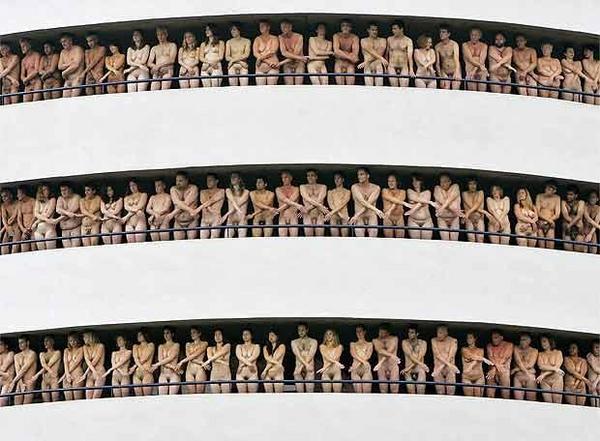 Spencer Tunick is this photographer who does nothing but arrange happenings where he takes pictures of large numbers of nude people in surprising public settings around the world. That certainly is something different. Nothing lewd about it, this is art. This one was Saturday in Amsterdam. [ Culture | 2007-06-05 00:12 | 5 comments | PermaLink ] More > |
| Monday, May 28, 2007 | |
| Ambient intimacy |
 Another reboot subject, Ambient intimacy, with Leisa Reichelt: Another reboot subject, Ambient intimacy, with Leisa Reichelt: 'Ambient Intimacy' is a term I coined recently to describe an ancient effect which has come to the fore with the use of technologies such as Flickr and Twitter. Evan Williams of Obvious (creators of Twitter) recently used this term at the International Conference of Weblogs & Social Media to explain the value that Twitter offers it's users.Excellent term. So, yes, Japanese teenage cellphone users, that's a good example. I forgot the numbers, but it is a surprisingly huge amount of SMSes they exchange every day on the average. With a cellphone, you can be in touch with your pals all the time, and you can coordinate all your activities, if you so wish, and keep each other informed. You can move around town, and organize impromptu meetings, and you no longer need so much of a schedule or planned meeting times and places. I haven't gotten into the twitter thing. For those who don't know, it is essentially that you receive SMSes that tell you little things your friends are doing. What they're eating for lunch, what they're watching on TV, what they're thinking about, or whatever else they'd want to share. I don't know, I think I'd find that a little annoying to receive as SMS. I like the idea that it is visible, though. Not all types of media are practical for this. Push media like e-mail or SMS or phone calls easily become annoying. I don't want to be contacted and interrupted to be told what somebody's having for breakfast, as I'll probably be asleep. What I wouldn't mind having would be a device that started me off with a global picture of where everybody I know are, and where I very easily could zoom in and see more. So, a global picture first, and then the detail. Doesn't have to start with location. It could be, ok, here's a graphic of what state these 50 people you care about are in. 5 are in meetings, 10 are sleeping, 15 are eating, 10 are commuting, 10 are hidden. And I can then look closer and see what else they're sharing. Within certain limits, I wouldn't necessarily mind having a webcam on top of my head so I could share what I was doing. I wouldn't leave it on all the time, but a good deal of time, I wouldn't mind. I wouldn't mind a GPS in my pocket that shared my position. Most of the time I wouldn't mind sharing info about what I'm doing. Automated and effortless systems for some of that could replace some of what blogging is about, and also turn it into something else. I probably wouldn't want to share all of it with just anybody, but there will always be people I'd happily let know most of what I do. Things like that will inevitably happen, as the technologies become available. At the same time we'll need better ways of being selective about what we want and don't want to share, and with who. [ Culture / reboot9 | 2007-05-28 22:46 | 2 comments | PermaLink ] More > |
| Sunday, March 11, 2007 | |
| One Million Splotz of Glue |
Lloyd Y. Asato's One Million Splotz of Glue Campaign: It begins with a question. What do you do to build community? Your answer, the action that you do to build community, is what we call Splotz of Glue.That sounds good. I don't understand exactly what it is. ... Hm, of course it might be just that: gathering little stories and ideas about building community. Maybe that'll just work somehow. The actual site for the Million Splotz thing is here, and is a blog, basically. Some commentary here from Doc Searls, who, when asked how he builds community answered this: The short answer: I don't. [ Culture | 2007-03-11 01:52 | 2 comments | PermaLink ] More > |
Page: 1 2 3 4 5 6 7 8 9 10 Older stories >>