I live in Toulouse, France where the time now is:
02:52
Contacting Me
I get many hundreds of e-mail messages per day and my inbox is becoming increasingly useless to me. So, if you write to me, don't count on an answer unless we know each other really well, or your communication is short and clear. Oh, I'm very friendly and approachable, but I don't have hours enough in my day to read everything.
ffunch -at- worldtrans.org
If you want your own
NewsLog like this,
or you want a
profile for
leaving comments,
join the New Civilization
Network
Everything I've written here is dedicated to the Public Domain.
The quotes from other people's writings, and the pictures used might or might not be copyrighted, but are considered fair use. Thus, overall, this weblog could best be described as being: Primarily Public Domain.
I have for many years held on to a particular model of human conscious evolution that I heard once. Read about it in my article here: The Singularity and the Fifth Dimension. It lays out how humanity is in the process of moving from the 3rd to the 5th "dimension" and what that actually means. And, note that, as I mentioned, it doesn't have to be taken as some new age spiritual kind of thing, but can just as well be a model of technological progress. and the required evolution in consciousness to deal with it.
Briefly, 3D was where things got done by getting the inspiration for them, by thinking about it, by getting in the mood, and then working hard on doing what it takes. Spirit -> Thought -> Emotion -> Effort -> Manifestation. The old-fashioned idea of: if you put your mind to it and work hard, you'll see some rewards in life, after quite a few years. Doing big things required large investments of physical effort and time.
4D speeded things up quite a bit. You still need inspiration and thought, but things start happening already when you're really in the mood, and you get other people in the right mood. Think advertising and think Internet overnight dot-com successes. Spirit -> Thought -> Emotion -> Manifestation. How much work went into something is no longer such an important factor. Facebook is worth more than twice as much as General Motors, even though it was a much much smaller effort. At the same time, what is there can crumble very quickly, when suddenly people feel different about it. The Arab Spring. Powerful centralized regimes can be toppled almost overnight.
Note that I'm saying, more or less, that we already went into that phase. It is more or less the epoch of the Internet.
But what about the next step? In case you follow me in imagining that something like this actually is going on.
5D is a further acceleration. Things happen when thought becomes coherent. It no longer matters so much what people really feel or what they actually are doing, or for that matter, what actually is there. The mere thought sends things off into a different direction. Spirit->Thought->Manifestation.
You might have interpreted that as instant magic, as if stuff would materialize in thin air the moment you think about it, but there's no reason to take it quite as literally. Just like the 4D Internet Age indeed changed things, but not to the degree that your feelings made things appear out of thin air. It is not direct creation as much at it is attraction. It is an organizing principle, not godly superpowers. With the arrival of the Internet, we started being attracted to what was exciting, or what was horrible, more than to what took lots of time and effort to build. Likewise, in the next phase, we organize ourselves based on something else, on clarity of thought, I'd say.
So, 5D, what might that actually look like?
I had provided some warnings about us totally not being ready for it, that we'd go crazy and/or blow ourselves up really quickly. And in some ways we are, but not quite as dramatically as I laid it out.
Group insanity has become a lot more apparent. Large groups of people believe themselves to live in realities that to most others are stark raving lunacy. US Politics provides plenty of illustration. This is quite different from different people simply having different beliefs. It is not just that some people prefer more spending on social programs and others prefer strengthening private initiatives. It is that the other guys seemingly are living in the world of Looney Tunes and are acting en masse as if it is totally real to them. And they in turn imagine some outrageous things about the folks you hang out with, seeing you as totally unable to deal with things as they really are.
It isn't just that some people go to church on Sundays and others on Saturdays, and some people don't like pork. It is that groups emerge seemingly overnight that get a lot of people to believe that everybody who doesn't believe the same things as them should be beheaded. Note that the same people will be willing and able to argue logically for that belief. Or think about the rather large group of people who believe that everybody who believes anything that is spiritual, metaphysical or religious is certifiably insane and there's absolutely nothing to discuss about it, they should just stop.
You'll notice that for a lot of those groups, a certain system of thought is what they aggregate around, and it is of little or no interest to try to calibrate their beliefs with what actually is there. Not that they don't calibrate against anything, but what they calibrate against is collections of thoughts, not what feels right, not what actually happened, not what anybody else might have to say.
We're seeing a split into many different realities. Realities that hardly overlap. People are living in worlds with drastically different rules and importances. In many respects, most of those worlds are fantasy worlds. People in them are stuck in the matrix, not having much of a concept of what is beyond it.
And you'll notice that, at the same time, we're at the brink of disaster. Out of control climate change, linked to ever accelerating pollution and resource depletion. Humanity might quite possibly make itself extinct in less than another century. And in a quite different way than back in the 1960s where it looked a lot like humanity might kill itself in global nuclear war. Back then, most people were very focused on the realities of the sides of the conflict. Today a lot of people will argue that the problem is not even there, and the important problems are some totally different things, like gay marriage or having the right religion.
As predicted, luckily not everybody has gone insane. The majority probably has. Oh, not necessarily in a "behead the infidels!!!" kind of way. For a lot of people, their insanity is simply to stay stuck in a little world where they have a job, and they have a family, and they stay busy with those things, and with the news and watching youtube, and with planning their retirement, and they don't really know that they're in a cabin on the Titanic and the captain is asleep.
So, how do we get used to it? How do we get on top of it? How do we survive it?
In the transition to the 4D Internet Age, there were some adjustments to make. The world became less stable and less solid, but there were still some guidelines for doing well. Don't count on a job for life. Learn to market yourself. Be interesting. Communicate. Don't bother to keep up with everything that goes on. Keep a finger in the air to notice which way the wind is blowing. If you need something, and you have your antennas out, it will probably come to you. No need to hoard it all in the basement in advance. Do what you feel is right, not what your parents told you you were supposed to do.
I'm not sure what the 5D world should be called. Not sure either what the principles are for surviving it, as we haven't done so yet. But, some possibilities:
There are no right thoughts. You need the flexibility to have options in how you think and be able to choose between them based on what works best. If you have only one way of thinking about something, you're stuck.
Information isn't reality, and should never be accepted at face value. If somebody tells you something, you need to be ready to evaluate whether that works for you, whether it can be verified against something observable, and whether it feels right to you.
To get anything to happen, you need to be able to name what it is. It needs to be a complete thought. Lots of other things are not needed. It doesn't have to be realistic or elaborately worked out, but it does have to be clear.
You have to be conscious of what you're thinking. You need to have a choice about it. If you merely go along with what is presented to you, you'll live in somebody else's fantasy world. If you consciously choose, you can change worlds.
The world comes together in the right way if you deliberately network the elements you choose to have in it. There's no ideology or group or method you simply can join which will make it all alright without you having to think. You have to think about every single piece. Think doesn't mean to repeat or rephrase something you've heard. It means to be conscious.
Thinking isn't some after-the-fact analysis. Thinking is a choice. You can only choose if there are options to choose from, or you create options. Not fake manufactured options of what brand of shampoo to buy, but options of actually different avenues to take. It is only successful if you calibrate against the results somehow.
Being a computer programmer has been one of my main sources of income for the past more than 30 years. More than half of it freelance, doing projects for people. I've noticed an important difference between very successful projects and not so successful projects.
Is there anybody to have the conversation with?
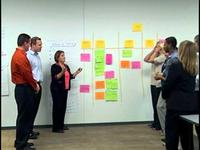
Software development is a type of knowledge work. Key parts of the work is to get to understand the problems at hand and inventing solutions for them. Because what needs to be done generally speaking isn't known in advance, it is being discovered along the way. Modern approaches to development, such as the Agile principles, take that into account by bringing all the stake holders together and engaging them in frequent conversation, and by progressing very incrementally.
But many people still mistakenly think that software is something mechanical. You just need to specify clearly what you want, and then the programmers need to just go and code it. That was how it was generally perceived a few decades ago. Analysts would write the specs for what needed to be done, and then we just needed to apply enough programmer man-hours to implement it. It never worked well, because once the programmers came back with the work, 6 months or a year later, and it was shown to the people who asked for it, they usually would realize that it wasn't really want they wanted, and they'll ask for changes. And the analysts would revise the specs and the programmers went off and did the work again, and came back some months later. That used to be the idea, but it is ridiculously wasteful and ineffective, so the approach has mostly been abandoned. However, that doesn't necessarily mean that it is easy to persuade clients that they need to be engaged in the process. Sometimes it is a very hard sell.
The most successful software projects I've done have involved a continuous conversation with some other people, often daily. That doesn't mean long meetings. Nowadays it means brief asynchronous instant messages, and occasional short face to face meetings. Doesn't have to be with everybody, but it should certainly include somebody who has a sense of what is needed, i.e. somebody who represents the interests of the end users. And, strangely, that's occasionally very hard to find, and it might make the project suffer greatly. Meaning, it will take a lot longer, be more costly, and most likely not deliver what really is needed.
The problem is in part that complexity is hard to understand. Complexity is something dynamic and alive that can't be all understood in advance, but that has emerging properties, which might or might not be the desired ones. This is as compared to stuff that is merely complicated. If it is complicated it might well be possible to make a big assembly diagram and have somebody simply follow the instructions. That works with many things, like Ikea furniture, but not with others, like software. Or communication. You can't just outsource an organization's social media relations and expect that it will work well. There needs to be somebody home who participates in a process of finding what works.
So, a note to myself: Face the issue up front. Don't accept a development project that the client isn't themselves taking part in. If they just want to tell you what they want and hear from you how long time it will take, walk the other way. [ Programming | 2014-11-01 17:33 | 8 comments | PermaLink ] More >
If we simply could keep track of which stuff is good and which is bad, things would be much easier. We aren't good at it, and for that matter, the manufacturers of stuff don't help us very much. In this video I present a Christmas present, a wine bottle opener, which just happens to work really well. It is ergonomic, the motor is strong, the battery lasts for a long time, the foil cutter actually does the job. But it is a no name brand Chinese thing, so it is hard for me to even recommend it to anybody.
After some search, and some help from a friend, I figured out that my wine opener is from Dongguan BeneFit Commodity Co.. Unfortunately they don't have that exact same model any longer. Was it a fluke that they made a great product, or do they do it consistently? I don't know.
My wife and I don't always see eye to eye on what it takes to learn something. I will quite readily accept that it might take years of hard work to acquire a particular skill. She will tend to think that an activity better start paying off right away, or it isn't really worth it. We both have some kind of point. Hers being in part that learning might as well be fun and rewarding from the beginning, and there's nothing noble about suffering through a process that won't provide a result before much later.
Learning is an important subject to me. I'd love to see better learning methods become available all around. I'm convinced that many things could be learned many times faster and much more thoroughly, if somebody would manage to understand how we learn, and would construct an approach that provided the required input and feedback. Instead, we're usually required to listen to somebody talking and look at some examples of the subject matter, and we're supposed to just learn from that. We do, but usually very slowly.
Until we have this learning robot that I can plug into, which will provide me instant feedback and just the right amount of repetition and variation, and which teaches the core structure of the matter, not all the random blahblah around it, it will take time.
People who've mastered a skill or a subject will know very well what kind of very substantial effort it took to get there. You're not playing classical violin in front of an audience unless you've practiced for years, hours and hours every day. You wouldn't be a stage magician with your own show if you hadn't practiced for thousands of hours to manipulate cards or coins until you do it so well that people don't see what you actually do. You won't be a Ph.D. unless you've digested a mountain of research in your particular field and you know pretty much everything that anybody else has said about it.
People who aren't in the process of mastering anything, or who haven't already done so, would tend to be very unaware of what it takes, and might even be quite likely to ridicule the work. Which is why it often happens out of sight.
My wife and I take dancing classes and enjoy going out dancing. But it is also an arena where our differences show up. In most partner dances, it is quite well known that the leaders and the followers have a quite different journey and different learning curve. The followers mostly focus on relaxing and not trying to anticipate what the leader will do. The leader on the other hand must know what to do, must know the sequence of steps and how to lead them and when to do them. Which obviously he can't do well from day one.
I hate the uncomfortable feeling of being a klutz who doesn't know what to do in a beginner class. Particularly if it seems to be easier for other people. And I'm really not fast at getting something new at first. My approach to keeping up will often be to put in an extra effort, study up on it in my own time, take the beginner class two or three times if I can.
I had started this dance that my wife wasn't yet doing at the time, West Coast Swing. I loved it right away, and decided to do what it took to learn it, even though it is considered quite difficult. So, I put in some extra effort, went to weekend workshops in a addition to the regular classes, watched videos, etc.
And now, here's the thing, that wouldn't go on for more than a few months before my wife would start making remarks like "You must be an expert by now, with all those classes you're taking". Or, when I'm signing up for another weekend class next month: "Do you really need to be an expert?".
If I wanted to be an expert and really master something, I should be practicing it for some hours every day. Not some hours every second weekend.
Many well-meaning people will be very interested when a friend or family member starts to learn something new. "You should give us a show!", "When are you going to perform?" two weeks after somebody starts learning to dance or play the violin.
There are surely activities that might be worth watching even when done by beginners. Most are not.
Some people (Malcolm Gladwell) say that you need to practice something for 10,000 hours to master it. That number is completely arbitrary and probably unfounded, but it gives the idea. That's something like 40 hours per week for 5 years. And doing that mindlessly, repeating the same actions over and over, surely wouldn't do it either.
Many people think they're not gifted or not able to learn, because they tried something a couple of times and they didn't succeed. You know, they tried making a drawing and it wasn't good. They obviously have no clue what it would take to succeed. Probably to a certain degree it is the fault of a general anti-mastery atmosphere. Or, we could say, a need for instant gratification. We celebrate people who've mastered fantastic skills, but we usually render the required work completely invisible, leaving the illusion that the mastery somehow was easy or didn't take much time.
Some people show up for the audition in American Idol or So You Think You Can Dance after having practiced for hours per day for years, and they do great. The show makes it look like they do what they do in a few days. Obviously the illusion fools enough people that some people will show up to the same auditions never having practiced anything, thinking they have a chance, and the only chance they get is to look like complete idiots in front of millions of people.
So, if you should be an expert by now, you should obviously have started years ago and have worked on it every day. It takes a lot of practice. And not just repetition of stuff one is trying to do, or that one is repeating in the wrong way. It takes attentive exploration of all aspects of what one is trying to learn. Getting to understand deeply why one has difficulty with some particular part, and how one can overcome it. And then moving on to some other part.
Most people who're really passionate about something, or who are trying to master something, will have a great need to talk about it or think about it. And, there again, unless they're surrounded by people who're passionate about the same thing or learning the same thing, they'll probably find that others have a very limited patience for this. We're used to the TV format. Sure, we'd like to see your audition, and a couple of snapshots of you practicing, and a few soundbites of you talking about your challenges, and then we'd like to see your performance, preferably flawless. But that's of course not really what has been going on. Again, they'd have been working on it for years, every day.
I'm writing in a blog here. Blogs could be a format for talking about what one really is working on, and others might be interested if they're on the same path. But not if they aren't. If you have a somewhat general blog, like this one, and you suddenly get passionate about something specific, and you start writing about that all the time, you would probably lose most of the audience. For example, I was really into aquaponics a couple of years ago. That meant that I spent hours every day doing research, trying to solve problems, or constructing things in the garage or in my greenhouse. I have written about that in other places. I could very well have written several posts here every day, but I didn't, because it would be much too much for most people. Right now I'm passionate about dance, and I could write about that every day. I don't, or I only do it in my private notes.
If you don't already have it, it would be a good idea to seek out a forum where your passion and your learning actually is welcome, also at great length. That's maybe really obvious to some who already have it, but not to others who didn't know where to look. You'd want to communicate with people who're on a similar level of involvement with the subject, or who would like to be. People immediately around you are not likely to follow you, so you might have to go out of the way to find the others. And if what you're into is something really specialized, it is quite possible that you won't find anybody else in the world who's deeply into that. Don't let that stop you. Later on, when you've succeeded, everybody will show up to congratulate you, including those who didn't really have the patience for you working so much on it, or who even tried to talk you out of it. [ Knowledge / learning | 2014-09-27 00:04 | 18 comments | PermaLink ] More >
At some point, a few years ago, I became good at saying wise stuff very concisely.
It was sort of accidental. The challenge I set myself was to say more things that were quotable. It is a Toastmasters principle that one ought to always have some material ready, in case somebody unexpectedly asks you to get up and speak to a crowd. Some stories, some jokes, some unusual facts, some quotes. One could simply collect some of those when one runs into them, put them on a list, and glance at them once in a while so that one is likely to remember them.
And I thought -- quotes -- I can't remember anything I've said that was quotable. Once in a while other people would quote me on something I had written years ago, and I usually was impressed. But I couldn't myself think of anything. So I decided to write it down when I said something that would make a good quote.
Incidentally, Twitter or Facebook are ideal for brief statements. On Twitter you simply can't write more than 140 characters, so if one has any hope of writing something memorable and meaningful, it would have to be within that limit.
I was quickly surprised to find that it was quite easy for me to say something quotable. I had just meant to try to catch it when I said something clever, but by doing that, I started mainly writing things that were clever and quotable. That maybe shouldn't be surprising, one typically gets what one puts one's attention on. Anyway, the result became that I more or less copied everything I said on Twitter or Facebook to my quote list right away. So, now, several years later there are hundreds and hundreds of entries on it.
It is worth noting that even though my initial motivation was somewhat vain and self-serving, to collect clever things I've said in order to sound smart and quotable later, it was something else I managed to tap into.
See, I can't really come up with something clever on command. If I try to deliberately construct a wise and profound statement, I generally can't. I'd sweat over it and just come up with something mediocre and unoriginal. Because it is not really about constructing something clever at all. It is more about discovering something.
The way it works for me is that I'm busy with something else and suddenly, bing, an insight pops into my head, fully formed. That has certainly happened for a long time. What was new now was that words came along with it. I could just write those words down, a sentence or two, and post them on Twitter or whatever. And I would probably pop right back to what I was doing before, having just spent a minute or so noting down or posting that thought.
The cool thing is that most of those little packets of wisdom could be unpacked to something much larger if necessary. If somebody has a question about it, I'd have a lot to say about it, and I'd have examples, etc. Or any of them could be a whole discussion, or a lecture, or a book, if necessary, and if I had time to write it. Or they could just stay brief. What is very useful about the brief form is that it is enough to remind me of exactly what it is about. So, even years later, I could still unpack it into a speech or an explanation. There'd be nothing to forget, because the initial quote says it all, even if it maybe isn't clear to most other people. And it almost always has a built-in integrity and coherence. Nobody ever catches me in having gotten it wrong. I don't particularly mean that to brag. I'm after all only partially responsible. Those thoughts pop into my head from I don't know where. I didn't try to construct them, they don't represent something I painstakingly have figured out. I can explain them after the fact, though.
The downside of saying many little things like that is that I might not get around to the bigger and longer and more detailed explanations and articles. And even though I myself was quite happy with my mini version, and a bunch of people clicked Like on it, I'm quite aware that probably most people didn't quite get what I meant. They might have entirely misunderstood it, or have at least filled a few of their own fixed ideas into it. The advantage of longer form writing, like blog posts, is that the subject matter can be unfolded and illustrated in a variety of different ways, and it is more likely that the reader gets it and that it becomes real and useful to them.
So, I will give myself the challenge of also collecting longer treatments of simple ideas I care about. [ Knowledge | 2014-09-26 15:15 | 6 comments | PermaLink ] More >
I've spent the last couple of months doing quite different things from what I normally have. I've been outside, digging in the garden, tinkering, using power tools. And I've been studying a bunch of new things I knew nothing about. Aquaponics, fish, plants, plumping, permaculture, forest gardens, and many sub-subjects of each. Now, this is really quite uncharacteristic. I.e. I've never been interested in any of those things before. But maybe it is not so uncharacteristic of me to dive deeply into a new subject.
What is new is that I might be writing more about it. Doing more physical things, building stuff, watching nature, surprise, that actually leads to lots of deep things to talk about. But I'll also just talk about those practical things, without any need for them to be deep. Resilient, local, distributed, empowering action has always been part of the subtext here. And there's lots of practical stuff it might be a good idea to start paying attention to. [ Diary | 2012-05-03 00:04 | 17 comments | PermaLink ] More >
There's no such thing. Certainly it isn't something you can steal. Quite the contrary, it is a license to steal. Specifically, it is a legal construct that gives an exclusive license to one party to stop all other parties from using certain words or certain pictures or certain designs or certain patterns of arranging things, simply because they were the first to claim that they invented those words or pictures, and that they own them. And the purported owner can then extort money from all the other people, or simply stop them from doing anything that looks like what they did.
It is a tired, tired old discussion, but intellectual property is not property. It is not in any way the same as when you own a physical object of some kind, and somebody can steal it. It is not even remotely that way, and you should be insulted if anybody suggests it. If you have a car, and somebody steals that car, by removing it from you and taking it into their possession, then obviously you don't have your car any longer, a car that took quite some resources to acquire, and which took raw materials to build. As opposed to that, with our modern technologies, ideas, words and pictures are extremely easily copied, for almost no cost, while leaving the original completely intact. Your car is still there, even if somebody took a picture of it, just like your website is still there, even though somebody saved a copy of it. Your car is also still there, even if somebody went to the trouble of building a copy of it. Copying is not stealing. Not even close. If you claim so, you're running some kind of scam.
The scam of Intellectual Property is quite similar to how you meet a con artist on the street. They seem friendly and they might ask you for a favor or invite you to play a little game. And before you know it, you owe them 100 dollars, and it isn't quite clear how it happened.
There's a lot of apparently friendly Intellectual Property around. If you turn on the radio, there are dozens of channels playing music non-stop. They actually broadcast songs over all civilized areas, from high powered emitters. Apparently free for anybody to pick up, as long as they have the receiver, which is cheap and ubiquitous. Nowhere are you presented with any contract that says that you'll be punished for saving any of this music, or sharing it with a friend. Turn on your TV and it is the same thing. Dozens of channels broadcasting high quality content to you non-stop, for free. The same people broadcast much of this content for free on the Internet. But if you ever get the idea that you can save some of it for replaying to yourself and your friends, you're suddenly a criminal, because you didn't then drive to a store to buy a CD or a DVD with the music or film you wanted to keep.
Intellectual property is like those apples one always hears about at Halloween, where some wacko embedded razorblades in them. They looked like a nice and friendly gift, but if you go off and actually try to eat them, you get hurt. Or it is like a crack dealer distributing free samples. Seems like a nice and friendly thing to do, but it is a gift you'll pay for later.
There are a lot of bogus cover stories you'll be presented with. It is to support the starving artists and musicians. They need to be paid for their hard work. It is just that those people are rarely the actual people you're being asked to pay. Sony is not an artist. Neither is Warner Brothers. They are businesses trying to make a profit. If you look into the accounting that applies to the majority of artists or authors that have record deals or publishing contracts, you'll find that the vast majority of them make nothing whatsoever, or they even have to pay out of their own pocket to be published. The people who make money are the very few really big names. The Madonnas and Brad Pitts. But much more so the media companies. The rest have been scammed as much as you have.
If you think it is a problem now, it can get much, much worse. Think about patents on DNA. Think about copyrights on 3D wireframe models. Think about big companies using courts to stop people from growing certain things in their gardens and from creating certain objects in their garages. In addition to stopping us from using certain words and certain melodies and certain images and likenesses. What could be a glorious future of local production and distributed creativity could instead turn into a nightmare dystopia where a few multi-national megacorps have the government backed power to turn off the things you create, or use, or grow, because they "own" them. Or have you pay them handsomely for the right to create.
One possible avenue, to avoid this, is to stay far away from anything that looks like Intellectual Property, to refuse to use it, to block it, ban it.
A new Internet2, free from copyrights and patents and any other kind of IP looks like a better and better idea. No, I don't mean a pirate network for sharing their stuff. I mean a network where intellectual property is banned. We just won't play their game at all.
Software has been created for the purpose of identifying "owned" materials, like music or film. Imagine using it in reverse in a new Internet. I.e. anything that is "owned" will simply not be transported. Not by its owners, not by anybody. It simply won't go anywhere. Nobody wants it. In other words:
If you have intellectual property, please keep it to yourself!
Which is what should have happened in the first place. We call your bluff. If you made it and you think it is yours alone, fine, keep it. But don't let us catch you handing it out as a free sample to anybody that you could hope to later entrap. If you really think it is YOUR photo, keep it to yourself in a shoebox or on your computer. Don't post it to thousands of people on the Internet, and then later claim that they stole it from you. They didn't. You gave it to them. So, don't, if you don't want to.
Hefty fines would be in order for anybody trying to distribute their own intellectual property in any way. Some number of dollars for each person you knowingly have distributed it to for free would be quite reasonable, if you then later make demands of money for the very same thing.
So, I'm suggesting reversing the game. Blow the cover off the game when you see it. Don't allow this kind of thing on your networks. It's a crime.
I'm well aware that there are very large and rich corporations that have made themselves the cultural gate keepers who somehow seem to own most of all music and film, and a lot of the words, despite them not having created any of it. And others corporations who seem to own any thinkable way of manufacturing most of the things we need. And, yes, I know that they somehow have bribed the governments of most countries to do their bidding, and their plan of turning their scheme into international law is well advanced. And they have plenty of ways of expanding their scam. Just like they can patent the vegetables in your garden and the cells in your body, they can of course also think up ways of making it seem like the music you create yourself and the videos you record violate their copyrights. They could very well have the power to position a copyright-refusing Internet2 as a haven for pirates.
But if, instead of buying into their game, feeling guilty when they entrap us into pirating their stuff, you recognize it for what it is, it will be a lot harder for them. If you create spaces where their stuff isn't allowed, it will slow them down. If you call them on it, fewer people will be fooled. There's still a chance that this civilization-killing scheme can be stopped and reversed.
Support people who create. Writers, musicians, photographers, artists, makers. Directly. Support their creativity. Help them make a living from it. Oppose corporations and their lawyers and politicians who make a system out of owning and stopping creativity and communication, profiting unscrupulously from the creative work of others.
Create loads and loads of new stuff. In new ways, in new media. Make it altogether impractical for them to keep up. Expand the commons faster than they can privatize it. Use and support stuff that is free. Pay for and reward added value, route around ownership. [ Information | 2012-01-24 00:50 | 36 comments | PermaLink ] More >
It can be stimulating and rewarding to once in a while take stock of what one has accomplished and what one aims at doing next. The new year is traditionally a good time for doing that. And, I'm in part inspired by such a post from Vanessa Miemis.
To illustrate one good reason for writing it down, when I at first think about what I might have accomplished in 2011, I draw a blank. Didn't really do much, and hadn't really planned anything either. But when one looks a bit closer, there's of course more there...
2011
In 2011 I regained hope. Not that I was particularly hopeless, but there was a certain cynicism that had crept in. A "been there, done that, it didn't work" kind of attitude, hovering behind my habitual optimism. Now, suddenly, there are lots of reasons to be hopeful. The right people are starting to connect in the right ways. Ideas gain traction that previously didn't. Conflicts that previously existed, no longer have much power. On the world scene, the centralized control system is crumbling fast. We have a unique opportunity to put something better in place. For the first time since the 1990s do I feel really energized and hopeful about this being the time when it is possible.
In 2011 I found my philosophical voice in a new way. That was actually a life hack. I'm a member of a local Toastmastersclub where people practice public speaking. It is a good piece of advice for a public speaker to collect material that will be ready for use whenever one is called upon to say something. Stories, jokes, quotes, that kind of thing. So, I made a document for recording good material when I ran into it. I made one of the categories My Own Quotes, i.e. stuff I've said that I can be quoted for, because I wasn't able to come up with anything at the time. Surprisingly, it turned out that I suddenly started saying more things that were quotable, on Twitter, on Facebook, etc. Which in turn, ironically, means I have little use for my list, as it is more fun to make up something new.
I've met a lot of people. Specifically, I now feel part of a global network of the "right" kind of people, which is really a mix of different kinds of people, but one that fits. And it is not one thing. Rather, I notice overlapping groups coming together, sort of under the surface, without formal leaders. Things are more likely to happen in hidden Facebook groups or private hangouts. Not that there's anything secret going on, but it seems more productive with self-selecting groups that invite new members personally, rather than very visible public groups and causes that people go and join for abstract reasons. The Next Edge is one name for a loose group that is quite happening.
In October I was in New York for a week. Participating in ContactCon, a MetaCurrencycollabathon, and hanging out on Liberty Square with Occupy Wallstreet. All of it very inspiring. Meeting a bunch of kindred souls I otherwise knew only online. And the Occupy movement added a very tangible and present focus, an incarnation of much that we're talking about, and a surprising inspiration that sends things in a new direction. It was enlightening to see how a small group of people sleeping under tarps in Zuccotti park could hold the world's attention. Very inspiring to experience the consensus process in a General Assembly.
In 2011 I began to see Dialogue happening online. I.e. it seems possible for small groups of people to share a space with each other in a mindful manner, without agenda, without posturing, without conflict, exploring the unknown together. I have previously attempted that, and failed, so it is new.
I decided to move forward with some of what I consider my own online projects, stuff I haven't gotten around to for years, despite not really having time. Ironically, since I'm busy being a paid programmer for other people's projects, I am now experimenting with outsourcing some of my own programming projects to others. It is still unclear whether it will bear fruit, but it is nevertheless satisfying to see activity.
I started adjusting my work environment more to my liking. I'm now working on a standup desk most of the time, which I think is more healthy.
2012
I'm intending to revamp my web presence, including sites that I'm responsible for that have been stagnant. Most important will probably be a long-awaited re-launch of newciv.org, with a somewhat different spin. But I'd also like to make my personal web presence more coherent, as it is spread over a number of sites now, hard to follow in one place. I also hope to launch one or two useful tools on the web that might gain some traction.
I'm right now really excited about taking up aquaponics. I.e. cultivating fish and vegetables together in a small eco-system. I'm right now learning what I need to know, but I plan on getting that all going this year. In a greenhouse, I'm thinking. I'm not otherwise somebody you're likely to find outside with his hands in the dirt, so this will require some learning. What motivates me is in part that it involves technology, besides it being completely organic and producing no waste. We already have chickens, we have a large backyard with fruit trees, and a well on the property, so we have good potential for being able to be quite self-sufficient.
The aquaponics thing will be one thing to inspire/force me to be more handy. I'm a software guy and haven't traditionally been somebody you'd find in the garage with power tools. But I'd like in various ways to be more of a maker and tinkerer. In part for the fun, in part for the self-sufficiency aspects, in part because I think the economy is going in that kind of direction. So, if I don't run out of money from buying aquaponics equipment, I'm thinking maybe 3D printing, maybe some kind of solar panel setup. We can't use the standard government sponsored approach to that, as we only rent this house. Oh, and I need webcams, so I can monitor my aquaponics setup, etc.
I have almost no network here locally of the kind that is in sync with what I'm into online. That is rather odd, if I compare with how it was for us in California. I hope to remedy that this year. That might be local groups that are into permaculture, local economies, the local fablab, co-ops, dialogue, etc.
My current choice for exercise and socializing and being more in my body is dance. So, I'll continue going to dance classes 3-5 nights per week. This year I hope I will master it to a sufficient degree, or maybe just relax with it, that it can be mainly the form of creative expression and social fun that I love, and not about remembering steps and sometimes awkwardly failing.
Oh, and I need to make money too. I'm aiming to become independent of paid work this year. I'm 1/3 of the way there. That is, 33% of my income is residual income from my own website projects. I'd like to get that to 100%, so that I can concentrate on doing what needs doing, not what I must do in order to make a living.
I intend to spend more time speaking the truth, or looking for it, if it isn't available. Less time being worried about what anybody else will think. Less time trying to please others even though things don't really fit. I will aim at being a conductor, not a resistor. Preferably a superconductor. [ Diary | 2012-01-02 13:52 | 13 comments | PermaLink ] More >
Here's to our 2012 being magical, synchronistic, surprising and resilient.
A year where everything might change, but what's truly important is found to be indestructible.
A year where dreams are no longer just dreams, where reality grows on trees, and people can do what they imagine.
A time where you'll meet exactly those you need to meet.
A space where those things connect that fit.
May you feel at home in the fabric of life.
[This was one of my answers on Quora a while back.]
The idea that there's a paying job waiting for everybody is going away.
It was a somewhat odd idea in the first place. Before jobs were invented, people mostly worked to house and feed their family. Quite strikingly, they did this by actually building the house and by actually growing the food. Nowadays, that's close to being illegal, as you most likely would violate building codes and zoning laws if you tried to do that in a western country. What happened in the meantime was that a very complicated system was invented, where one would go out and work for other people, then buy what one needs from others, before one can go back home and enjoy it.
One of the problems with the scheme is that there's no very good regulating mechanism for jobs. There's one for money, albeit a flawed one. If there is not enough money to pay for stuff, central banks have the job of putting more money into circulation. If there's too much money out there, it is their job to get rid of it, thus keeping the money supply fairly stable, corresponding roughly to what is there to pay for. Again, there are many problems with this, but at least there's a system to keep it stable.
There's no system that automatically creates more jobs when there are some people who need them, or that retires some jobs if there's nobody to fill them. Governments try to do it, but unless they're centralized socialist governments, they don't have direct ways of doing it. A direct way would be to hire more people if there are people without jobs. What they do is indirect stuff, in the form of "stimulating" the economy in various ways. Sometimes they do this in ideological ways that might not even work, or that might do the opposite. For example, there's the supply-side philosophy that is popular with neo-conservatives in the United States. The idea is that if you give more money to rich people, they're smart enough to do things with it that creates more business, and thus more jobs. Then again, they might just invest it in some other ways, or buy gold-plated swimming pools for it. Or they might buy robotic factories, not creating very many jobs. Supply-side is seen in contrast to demand-side economics, which would stimulate the economy by giving regular people more money, inspiring them to go and spend it, thus getting the wheels turning. There's no guarantee that this creates more jobs either, as the stuff people are buying might still be produced in robotic factories and in another country.
More things are being produced with less and less effort. Production is becoming automated. Fewer and fewer people can create more and more. This increased efficiency could potentially do many good things, but what it certainly doesn't do is produce more jobs. It naturally produces fewer jobs. And the benefits of the increased efficiency are largely kept by the owners of the production machinery. Yes, people get cheaper stuff too, but they don't get the jobs that would pay them so they can afford to buy it.
This system is going to break sooner or later, but that's a different discussion.
In the meantime, jobs are being replaced, increasingly, with being in business by yourself. You'll have noticed, even if you have a job, that you've had to compete to get it, to market yourself, to track down prospective employers, package yourself right, etc. There are rather few jobs just standing around waiting for you. Jobs aren't secure either, even if you have them. It is extremely unlikely to last your whole life, so you'll have to do it over and over. So, more people are going on to the next step, of being freelance and learning how to actually market their services, find customers, etc. Since you're becoming freelance anyway, you're also more likely to choose a line of activity that actually interests you, more than a regular job would.
Another intriguing trend is likely to close the loop and take us back to a more sustainable and local way of living. As technology advances, it becomes possible to manufacture more stuff by yourself. Think about 3D printers and open source hardware and software. As the global economic system is becoming more uncertain and unstable, we perceive more of a need for taking care of our needs locally. The right combination of technologies will increasingly make it possible.
So, one way or another, we're actually quite likely to get back where we started, but at a much higher level. I.e. that you work on what you actually need and what you feel like working on. You will need to network economically with other people, but no job needs to be involved.
It would be a good idea to start right now to get used to the idea. Drop the job thinking. Think about having skills that will be needed and useful, whether there's a job for it or not. Think about understanding who needs your services and how you can reach them. Think about organizing your life so that you might still eat and have a place to live, even if business is slow. [ Culture | 2011-12-01 17:56 | 27 comments | PermaLink ] More >







![[Valid RSS]](http://www.newciv.org/pic/valid-rss.png "Validate my RSS feed")